A question readers often ask

The Five Love Languages and The New Love Languages: What’s Different?

From understanding how you express affection to exploring the energetic patterns shaping how you love.

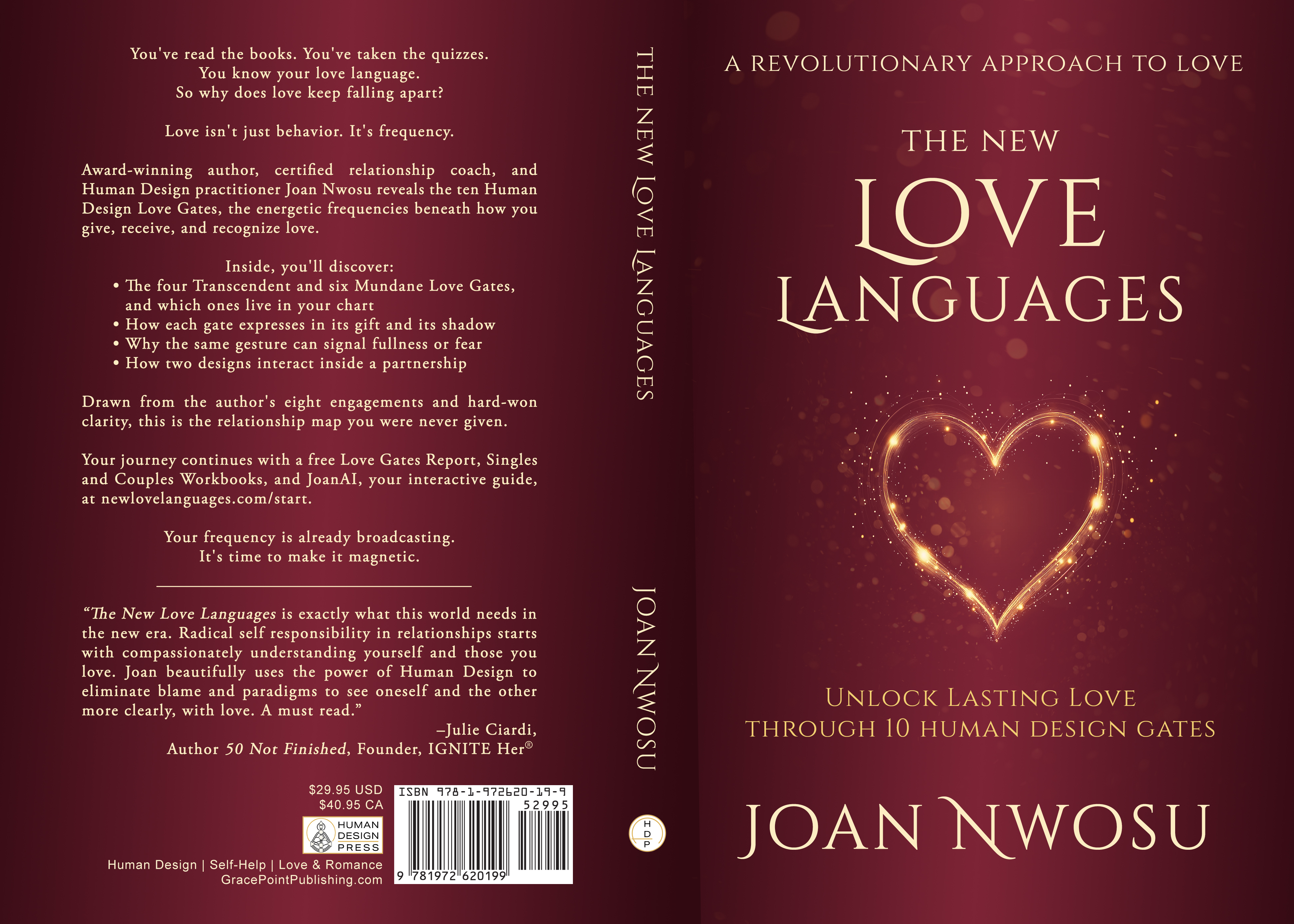
Cover of The New Love Languages by Joan Nwosu

You may already know your love language.

Perhaps you feel most loved through uninterrupted time together. Perhaps thoughtful words stay with you long after a conversation ends. Perhaps someone taking something off your plate means more than an elaborate gift.

Having language for those preferences can make it easier to ask for what matters and recognize the care someone is offering.

But you might also know your love language and still find yourself wondering:

Why do I give so much and struggle to ask for anything?

Why does the beginning of a relationship feel more compelling than the relationship itself?

Why can I feel deeply loved and still lose touch with what matters to me?

These are some of the questions I explore in The New Love Languages.

01 / 08

What the Five Love Languages offers

Gary Chapman’s The 5 Love Languages describes five ways people express and experience affection: Words of Affirmation, Quality Time, Receiving Gifts, Acts of Service, and Physical Touch.

Its central invitation is to understand which expressions of love matter to you and to the people you care about. That can open a useful conversation when one person believes they are showing love and the other struggles to feel it. Explore Gary Chapman’s framework.

For example, one person might show care by doing practical things, while their partner longs for time together without distractions. Recognizing that difference gives them something specific to discuss.

The New Love Languages brings another question into that conversation:

What energetic patterns may be shaping the way I give, receive, pursue, and experience love?

02 / 08

What is Human Design?

Human Design is a system of self-knowledge introduced by Ra Uru Hu. It brings together elements of astrology, the I Ching, the chakra system, and Kabbalah in a chart called a BodyGraph, calculated using your birth date, time, and place.

Within Human Design, the chart’s centres, channels, and gates are interpreted as aspects of your energetic design. The system explores themes such as how you engage with life, experience other people, and approach decisions.

Ra called Human Design the “Science of Differentiation,” emphasizing individuality and encouraging people to experiment with its teachings in their own lives. Read more about Human Design’s origins.

In The New Love Languages, I use Human Design as a reflective lens for exploring love and relationships. Its interpretations are invitations to self-inquiry, rather than scientifically established explanations of your personality or predictions about your future.

You can consider what resonates, question what does not, and return to what your actual experience shows you.

03 / 08

What are the 10 Love Gates?

The book focuses on 10 gates within Human Design, exploring their themes through love and relationships.

These themes include fantasy, dedication, emotional depth, purpose, self-love, and universal love. They offer language for considering patterns you may recognize in your attractions, expectations, ways of giving, and responses to closeness.

When I speak about energetic patterns, I mean these recurring themes as understood through the Human Design lens: what draws your attention, how you engage, where you feel pulled to give or protect yourself, and how those tendencies may be expressed in relationships.

The book brings those themes into everyday life through stories and shadow and gift expressions.

A shadow expression helps you notice where a pattern may become constraining or costly. A gift expression offers a more conscious way to work with that theme.

Dedication, for example, can become an exhausting effort to earn love. That same capacity for devotion can also be expressed through generosity that respects your needs and limits.

These are possibilities to explore. A Gate does not establish your motives or define your character.

04 / 08

The same act of love can carry different meanings

Consider Acts of Service.

You organize the weekend. You remember the appointment. You take on the task your partner has been avoiding.

Those actions may be freely chosen expressions of care. You enjoy contributing, you can say when you are tired, and there is room for your needs too.

At another time, you might do those same things because being useful feels like the safest way to remain loved. You keep giving beyond your capacity. You hope your partner will notice what it costs. When they do not, resentment begins to build.

From the outside, both situations can look like generosity.

From the inside, they feel very different.

In The New Love Languages, Gate 40 provides a lens for exploring earning love and dedication. It invites you to notice when giving becomes tied to proving your worth, and what sustainable dedication could look like instead.

You might ask:

  • Can I offer this freely?
  • Can I say no without feeling that my place in the relationship is at risk?
  • Have I expressed what I need, or am I hoping my effort will speak for me?
  • Am I keeping a private ledger of what I give and what I receive?

Knowing that Acts of Service matters to you can help you communicate affection. Exploring the pattern around your giving can help you understand your experience of it.

You do not need Gate 40 in your chart to recognize yourself in those questions. Your chart offers a starting point for reflection; your lived experience remains essential.

05 / 08

How the two approaches differ

How the two approaches differ
DimensionThe Five Love LanguagesThe New Love Languages
Main focusPreferred ways of expressing and receiving affectionEnergetic relationship patterns explored through 10 Human Design Love Gates
Starting questionWhich expressions of love feel meaningful to me and my partner?What patterns may be shaping how I experience and express love?
ApproachRecognizing preferences and communicating careExploring your design, lived experience, and shadow and gift expressions
Practical useDiscussing how affection is offered and receivedDeveloping self-knowledge and more conscious ways of relating

The New Love Languages is my independent work. It is not a sequel to, or an official extension of, Gary Chapman’s framework.

You can find value in both approaches. You may appreciate knowing that quality time matters to you while also exploring what happens when closeness becomes a reason to abandon your own interests, friendships, or direction.

06 / 08

Why I wanted to explore these questions

I came to this work with relationship experience, self-awareness, and a willingness to learn.

I had explored familiar frameworks. I could name things I wanted and recognize some of my patterns. Yet I still found myself inside relationship experiences that were difficult to understand.

Discovering the Love Gates gave me another language for examining those experiences.

It helped me become curious about what I had been interpreting as personal failure. I could explore the patterns around my choices and consider how I wanted to relate differently.

That experience became part of the foundation of The New Love Languages.

I wrote the book for people who have done the work and still sense that something important in their relationship story remains unnamed. I also wrote it for couples who want to better understand the meaning each person brings to love.

07 / 08

How self-knowledge becomes discernment

Understanding a pattern gives you something to work with. What matters next is how you use that understanding.

This is where my wider work in Relationship Intelligence comes in.

Relationship Intelligence helps you observe what is happening, examine the meaning you assign to it, and make more conscious relationship decisions.

You might recognize that you are drawn to a person’s potential. Discernment then asks what they are actually showing you today.

You might recognize that dedication matters deeply to you. Discernment helps you consider whether the relationship has room for mutual care, honest limits, and repair.

You might understand why a connection feels powerful. You can still ask whether your everyday lives fit and whether you are choosing a direction you both want.

The REAL Attraction Pyramid™ helps structure that exploration through Chemistry, Compatibility, and Conscious Alignment.

Feeling drawn to someone, functioning well together, and choosing a shared direction each deserve attention.

Neither a love-language preference nor a Human Design chart can decide those questions for you. Your conversations, choices, and experiences together provide information you need to consider.

08 / 08

You can begin wherever you are

If you are single, this work can help you reflect on who you are in love, what you bring to a relationship, and which familiar patterns deserve a closer look.

If you are dating, it can help you stay connected to yourself while discovering someone else.

If you are partnered, it can give you language for experiences that have been difficult to explain. The invitation is to approach each other with curiosity, allowing each person to describe their own experience.

You do not need to become an expert in Human Design before opening the book. Begin with a question you recognize. Notice what resonates. Consider it alongside what you have actually lived.

You may already know how you like to be loved. There is still more to discover about who you are when you love.

The New Love Languages invites you into that discovery through personal stories, the 10 Love Gates, and reflection on the choices that shape your relationships.

Explore The New Love Languages

Would you like to see your own Love Gates first? Get your free Love Gates Report.